Originally published on Jayanta's Substack (News from Periphery).
One year after India's labour codes made the eight-hour day the national rule, the line is being redrawn from Athens to Mumbai. How was it won, and is it worth defending?
About this post: Adapted from my longer research write-up on the history and legal status of the eight-hour workday. Every fact stated here was checked against the primary or authoritative source linked at the end; nothing was added without a source. AI tools were used for research assistance, fact-checking and drafting under my supervision; final editorial authority rests with me.
Here is a simple question with a surprisingly complicated answer: why does almost no sensible manager put more than eight hours a day on an employee’s contract?
Think about it. Delivery apps shave seconds off a courier’s route. Boards demand growth every quarter. Yet even the most aggressive founder hesitates before writing “twelve hours a day” into an appointment letter. Extra work still arrives, of course. It comes as a “quick” WhatsApp message at 10 p.m., a Sunday email, a call during the commute. But on paper the number stays stubbornly at eight.
Why eight? Why not seven, or nine, or eleven?
We tend to treat the eight-hour day as a law of nature, like our need for sleep. It is nothing of the kind. It is a historical truce, built from a mill owner’s idea, a philosopher’s argument, strikes that cost lives, a revolution that frightened governments, and one industrialist’s cold arithmetic.
And today, 21 November 2026, is a good day to tell that story. Exactly one year ago, India’s four labour codes came into force and made eight hours a day the national baseline. In the same twelve months, Greece legalised 13-hour days, Germany drafted a way around its daily cap, and Indian states tried to push factory shifts to 12 hours.
Facts nobody disputes
• The slogan “eight hours’ labour, eight hours’ recreation, eight hours’ rest” is credited to the Welsh mill owner Robert Owen, around 1817.
• The ILO’s very first convention (1919) set 8 hours a day and 48 a week for industry. India ratified it in 1921.
• The US Fair Labor Standards Act (1938) never capped the working day. It priced the working week: time-and-a-half after 40 hours.
• India’s Factories Act, 1948 allowed 9 hours a day. The Occupational Safety, Health and Working Conditions (OSH) Code, in force since 21 November 2025, sets 8 hours a day and 48 a week, with overtime at double pay.
• WHO and ILO estimate that 745,000 people died in 2016 from stroke and heart disease linked to working 55 hours a week or more.
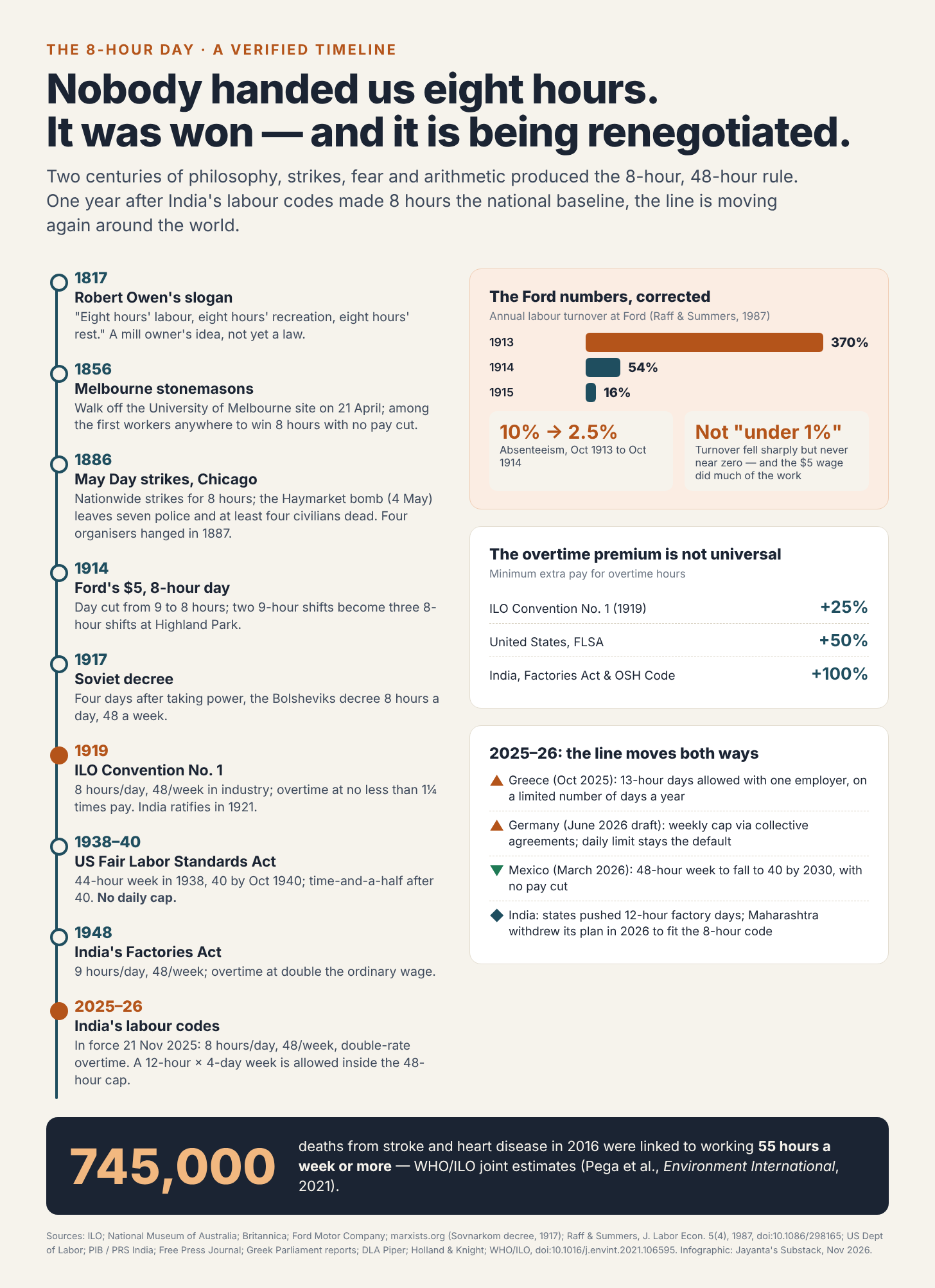
“Eight hours labour, eight hours recreation, eight hours rest”
Before factories, work was brutal but it had a natural brake. You worked while the sun was up, slowed in winter, and stopped for festivals.
Steam engines removed the brake. A loom does not tire; it only depreciates. Every idle hour cost the owner money, so the human being was made to keep pace with the machine. In the early nineteenth century, many factory workers in Britain, Europe and the United States worked 12, 14, even up to 18 hours a day, six days a week.
Robert Owen, who ran the cotton mills at New Lanark in Scotland, saw what his fellow owners chose not to see: an exhausted workforce is a broken one. His answer was geometry. Split the 24-hour day into three equal parts. Work. Rest. And a third part that was radical for its time: recreation, meaning time for family, reading, learning and civic life.
His fellow mill owners thought leisure would make workers idle and drunk. Owen cut hours at New Lanark and stayed in business. But a good example rarely moves an industry. The idea needed something sharper than conscience.
“Between equal rights, force decides”
Fifty years later, Karl Marx supplied it. In the first volume of Capital (1867), in a long chapter called “The Working Day”, he asked what an employer actually buys when he hires a worker for a day.
His answer was labour-power: the capacity to work, which cannot be separated from the living person. In the first few hours, the worker produces value equal to the wage. Everything after that is profit. So the owner always wants a longer day, and the worker always needs a shorter one.
Both sides, Marx noted, can cite the law of contract. The buyer says: I paid for a day, I will use all of it. The seller says: you bought my labour, not my life. Then comes his famous line: “Between equal rights force decides.”
You do not have to be a Marxist to see the point. A working-hours limit is not a natural price set by the market. It is a boundary someone has to hold.
Melbourne, Chicago, and the cost of a number
The first breakthrough came from stonemasons. On 21 April 1856, masons building the University of Melbourne downed tools and marched to Parliament House. A gold-rush labour shortage gave them leverage. They won eight hours with no cut in pay, among the first workers anywhere to do so.
Thirty years later the fight moved to the United States. American unions set 1 May 1886 as the date for a national eight-hour day, and hundreds of thousands struck. In Chicago, after police killed strikers at the McCormick works, a protest rally at Haymarket Square on 4 May ended with a bomb thrown at police and gunfire. Seven police officers and at least four civilians died. Eight anarchists were convicted after a trial widely seen as unfair; four were hanged in November 1887.
The executions did not kill the movement. They gave it martyrs, and May Day became the international workers’ day.
Same demand. Two continents. One with a parade, one with a gallows.
Fear in 1917, insurance in 1919
Then a revolution changed the calculation. Four days after seizing power in Russia, the Bolsheviks issued a decree limiting work to eight hours a day and 48 a week.
For Western governments facing returning soldiers, unemployment and strikes, this was no longer a labour dispute. It was a threat. When the Treaty of Versailles created the International Labour Organization in 1919, the preamble of its constitution was blunt: injustice and hardship at work produced “unrest so great that the peace and harmony of the world are imperilled”. Its first example of a remedy was a maximum working day and week.
The ILO’s first convention, adopted in November 1919, set eight hours a day and 48 a week in industry. Overtime, where allowed, had to be paid at least one and a quarter times the normal rate. Rich governments did not suddenly love Owen’s poetry. They bought insurance against revolution, and eight hours was the cheapest policy on offer.
A footnote worth knowing: according to the ILO itself, only 46 of its 187 member states have ratified Convention No. 1. India is one of them. Its influence came less from ratification than from becoming the global common sense.
The capitalist who did the arithmetic
The most surprising convert was Henry Ford.
His moving assembly line at Highland Park, Michigan, cut the time to build a Model T dramatically. It also made the work so monotonous that men simply walked out. In 1913, Ford’s annual labour turnover was 370 per cent: to keep about 13,600 people on the payroll, the company recorded more than 50,000 departures.
On 5 January 1914, Ford announced the “Five-Dollar Day”. Pay for most workers more than doubled from $2.34 a day, mainly as profit-sharing with conditions attached. The day was cut from nine hours to eight. And here is the engineering trick: two nine-hour shifts became three eight-hour shifts, so the expensive machinery could run around the clock. The next morning, about 10,000 people queued at the gate.
Did it pay? The economists Daniel Raff and Lawrence Summers checked the company’s own figures. Turnover fell from 370 per cent in 1913 to 54 per cent in 1914 and 16 per cent in 1915. Absenteeism fell from 10 per cent to 2.5 per cent. Net income rose from about $27 million in 1913 to about $40 million in 1915.
A warning here, because a popular infographic on this topic gets it wrong: turnover never fell to “under 1 per cent”, and the shorter day did not do it alone. The doubled wage did much of the work.
In September 1926, Ford went further: a five-day, 40-hour week. His reasoning was pure business. People with no free time do not buy cars, clothes or holidays. As he put it in the company newspaper: “It is high time to rid ourselves of the notion that leisure for workmen is either lost time or a class privilege.”
Owen argued that leisure makes better people. Ford argued that leisure makes better customers. Both arrived at eight hours.
The law that put a price on overtime
Voluntary adoption was patchy, so the United States wrote the limit into law during the Great Depression. The driving force was Frances Perkins, the first woman to serve in a US presidential cabinet. In 1911 she had witnessed the Triangle Shirtwaist Factory fire in New York, where 146 people, mostly young women, died behind locked doors.
The Fair Labor Standards Act of 1938 was clever. It did not ban long hours. It made them expensive. The act began with a 44-hour week, stepped down to 40 hours by October 1940, and required time-and-a-half pay beyond that. It set no daily limit at all.
That difference matters. America protects the week through price. The ILO and India protect the day through law.
India: from nine hours to eight
India’s story usually starts with a popular claim: that B. R. Ambedkar, as Labour Member of the Viceroy’s Executive Council in the 1940s, cut the working day from 12 hours to eight. He did steer important amendments to factory law. But the statute book is more modest. The Factories Act, 1948, which governed Indian factories for 77 years, allowed nine hours a day and 48 a week, with overtime at double the ordinary wage.
A strict eight-hour daily rule came only with the OSH Code. The labour codes took effect on 21 November 2025, merging 29 central laws into four. The OSH Code alone absorbed 13, including the Factories Act. The central OSH rules followed on 8 May 2026.
The government describes the new limit as “8 to 12 hours per day, 48 hours per week”. That phrase hides the real design. The Labour Ministry has clarified that a company may run four 12-hour days followed by three paid holidays, as long as the week stays within 48 hours.
So the day is flexible; the week is fixed. Read it as a 48-hour budget that can be spent in eight-hour or twelve-hour instalments.
The states that wanted twelve
The pressure to spend that budget in longer days came early. In 2023, Karnataka amended the Factories Act to allow 12-hour days (including rest intervals) within the 48-hour week, and roughly doubled the quarterly overtime ceiling to about 145 hours with written consent. Tamil Nadu, Telangana, Uttar Pradesh and Tripura made similar moves.
Maharashtra’s cabinet approved 12-hour factory days and 10-hour days in shops in September 2025. Then the codes arrived. In March 2026 the state withdrew both proposals, telling the Assembly that the central code sets an eight-hour day.
A state retreating to fit a national floor. That is the eight-hour truce working as designed.
70 hours, 90 hours, and 745,000 deaths
The debate in India is not only legal. In October 2023, Infosys co-founder N. R. Narayana Murthy urged young Indians to work 70 hours a week. In January 2025, L&T chairman S. N. Subrahmanyan went further, suggesting 90 hours, Sundays included.
The government’s own Economic Survey 2024–25 answered, citing studies that work beyond about 55 to 60 hours a week harms health.
The evidence behind it is large. The WHO and ILO estimate that in 2016, 398,000 people died of stroke and 347,000 of heart disease because they had worked at least 55 hours a week. Compared with a 35 to 40-hour week, that schedule carries an estimated 35 per cent higher risk of stroke and 17 per cent higher risk of dying from ischaemic heart disease (Pega et al., 2021).
A 70-hour week is not ambition. On this evidence, it is a health risk with a motivational slogan attached.
The line is moving everywhere
India is not alone in renegotiating the truce, and the movement runs in both directions.
• Greece passed a law in October 2025 allowing 13-hour days with a single employer on a limited number of days a year, after two general strikes.
• Germany published a ministerial draft in June 2026 to let collective agreements set a weekly rather than a daily maximum. Unions called it the end of the eight-hour day; lawyers note the daily limit remains the default.
• Mexico went the other way. A constitutional reform published in March 2026 will cut the legal week from 48 to 40 hours by 2030, two hours a year, with no cut in pay.
• Britain and the EU never had a general daily cap. The EU limits the week to 48 hours on average and guarantees 11 hours of rest a day; the UK lets workers opt out of even the 48-hour limit.
Notice the pattern. Hardly anyone attacks “eight hours” head on. They move the measuring unit from the day to the week, and let the day stretch.
The overtime that never appears on paper
There is a quieter erosion, and it needs no amendment at all.
The eight-hour day was built for a world of factory gates. When you walked out at five, the boss could not reach you. Today the gate is in your pocket. An email answered at 9.30 p.m., a group chat checked at Sunday breakfast, a slide deck finished on a holiday: none of it appears in a register, and none of it attracts double pay.
In December 2025, MP Supriya Sule introduced a Right to Disconnect Bill in the Lok Sabha, giving employees the right to ignore work calls and emails after hours without penalty. It is a private member’s bill, and such bills rarely become law. But it names the right problem.
So, is the eight-hour day worth defending?
Yes, with qualifications.
Not because eight is a sacred number. Owen chose it for symmetry, Ford for shift arithmetic. A seven-hour or a 40-hour norm could serve as well, and Mexico is proving that a country can move the line down.
What deserves defending is the principle behind it: that a worker’s day has a ceiling, that crossing it has a price, and that the price is paid by the employer, not by the worker’s heart. India’s new code keeps that principle for factories and registers. Its weak point is everything a register does not see: the 12-hour option chosen under pressure, and the unrecorded hours on the phone.
What does this mean for you?
• If you are an employee in India, your normal week is capped at 48 hours, and overtime is meant to be consent-based and paid at double the ordinary rate. Check your appointment letter, now mandatory under the codes.
• If you are an employer or manager, the 12-hour, four-day week is an option, not a loophole. The 48-hour weekly limit still applies, and the health evidence on long hours is not in your favour.
• If you work from a laptop, the law has not caught up with you. Your protection, for now, is a team norm about when messages wait until morning.
• Wherever you are, watch the unit of measurement. A change from “hours per day” to “hours per week” can sound technical and still lengthen your day.
The eight-hour day was never a gift. It was a receipt, and receipts are only worth something if someone keeps them.
The honest limits of this piece
This is a history-and-law explainer, not legal advice. Labour law in India is on the concurrent list, so state rules matter and are still being notified; check your own state’s position. Several Indian figures in reporting differ slightly (for example, Karnataka’s overtime ceiling is reported as both 144 and 145 hours a quarter). The WHO/ILO deaths estimate is modelled from surveys, not counted case by case. And the claim that Ambedkar personally introduced the eight-hour day is common but not borne out by the 1948 statute, which allowed nine.
About the research
This post draws on my longer write-up, The Invisible Ceiling of the Eight-Hour Day: A Legal, Historical and Comparative Analysis of Working Time Regulations Worldwide and in India, which is yet to be published.
Verified external sources
• Press Information Bureau / Ministry of Labour and Employment: Implementation of the four Labour Codes (21 Nov 2025)
• PRS Legislative Research: OSH (Central) Rules, 2026
• PRS Legislative Research: Factories (Karnataka Amendment) Bill, 2023
• People Matters: Four-day week not mandatory, Labour Ministry clarifies
• Free Press Journal: Maharashtra pulls back working-hour reforms (Mar 2026)
• Business Today: Murthy, Subrahmanyan and the Economic Survey on long hours
• Business Today: Right to Disconnect Bill, 2025
• ILO: Convention No. 1, a landmark for workers’ rights
• Constitution of the ILO (text): Wikisource
• Karl Marx, Capital, Vol. I, Ch. 10: The Working-Day
• Sovnarkom: Decree on the Hours of Labour (1917)
• The Conversation: Robert Owen at 250
• National Museum of Australia: Eight-hour day
• Encyclopaedia Britannica: Haymarket Affair
• The Henry Ford: Ford’s Five-Dollar Day
• Ford Motor Company: The $5 workday and the third shift
• Raff, D. M. G. & Summers, L. H. (1987). Did Henry Ford Pay Efficiency Wages? Journal of Labor Economics, 5(4), S57–S86. doi:10.1086/298165 (working paper: NBER w2101)
• TIME: Ford’s five-day week, 25 Sept 1926
• US Department of Labor: FLSA 1938: Maximum Struggle for a Minimum Wage
• US National Park Service: Frances Perkins
• WHO: Long working hours increasing deaths from heart disease and stroke
• Pega, F. et al. (2021). Global, regional, and national burdens of ischemic heart disease and stroke attributable to exposure to long working hours. Environment International, 154, 106595. doi:10.1016/j.envint.2021.106595
• Euronews: Greece approves longer working hours (Oct 2025)
• Simmons & Simmons: German Working Time Act draft
• Holland & Knight: Mexico enacts 40-hour week reform
• European Union: Working hours rules
• GOV.UK: Maximum weekly working hours


No comments:
Post a Comment