This article was first published on News from Periphery (Substack).
A film shot in a bamboo-walled studio in 1935 started it all. Why did Assam's cinema nearly die, and how did it come back?
Nov 27, 2026 ·
Professor and Director, Bhupen Hazarika School of Mass Communication, Krishna Kanta Handiqui State Open University (KKHSOU), Guwahati
Disclosure: This article is adapted from my study unit on the history of cinema in Assam. No new facts have been added beyond that research. AI tools were used under my supervision; I had the final say on every word.
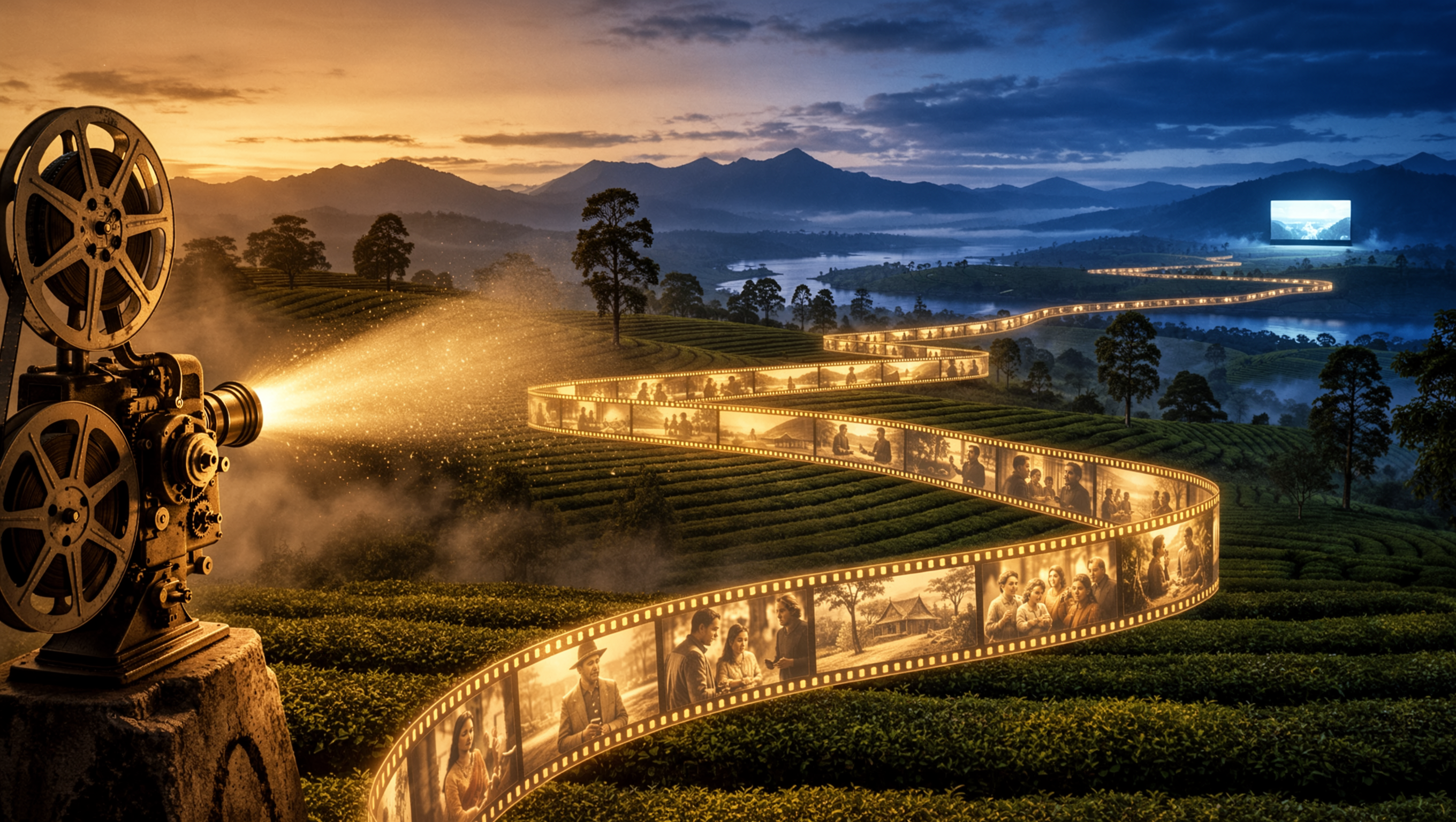
AI-generated illustration: a projector beam over a tea garden turns into a river of film.
Here is a simple question with a surprisingly complicated answer: how can a state win India’s highest film honours and still lose most of its cinema halls?
Assam has done exactly that. Its films have won the country’s top award for Best Feature Film twice. One was India’s official entry to the Oscars. Yet for two decades, Assamese cinema struggled to find a screen at home.
To understand why, we have to go back to a tea garden in 1933.
Facts nobody disputes
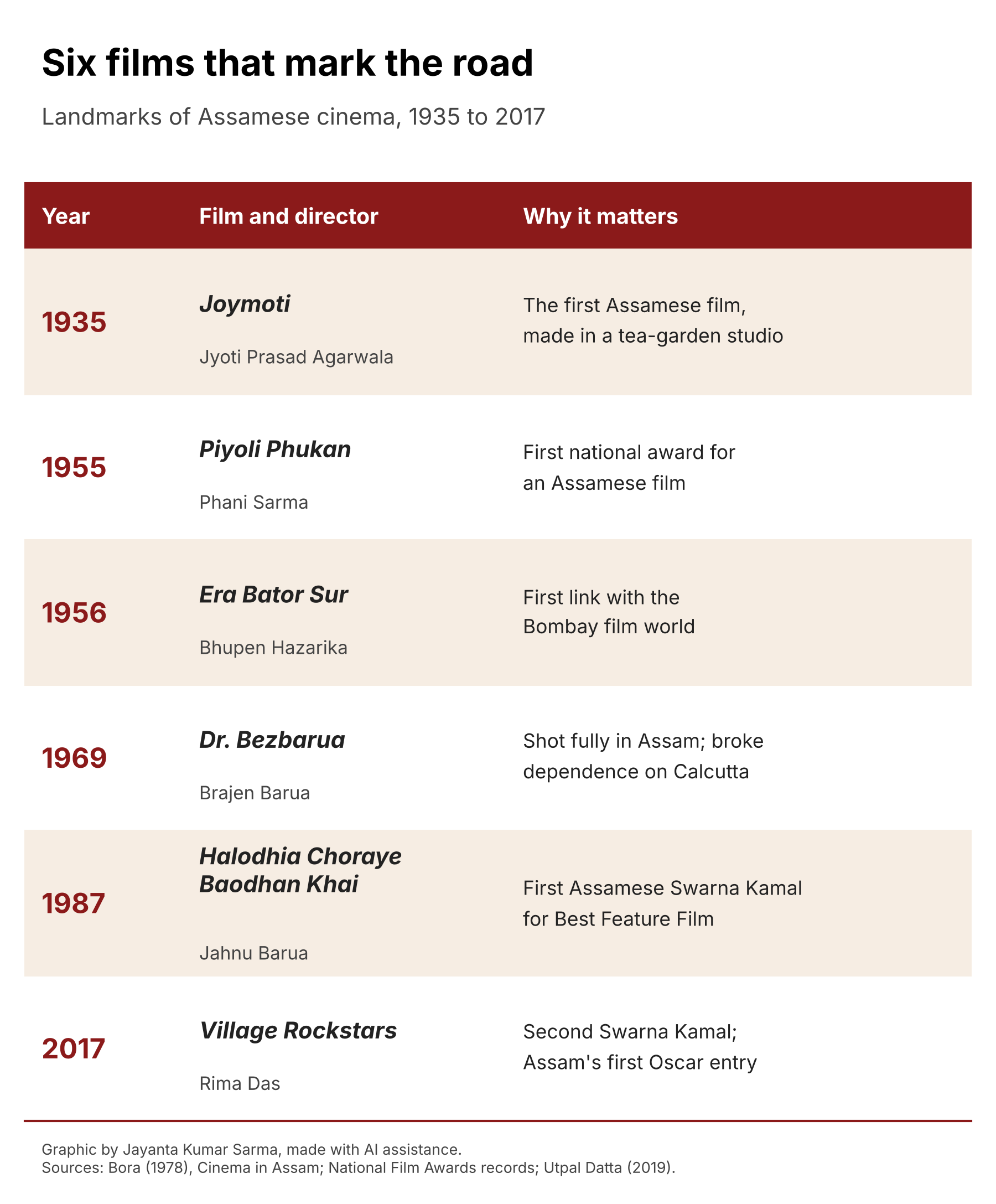
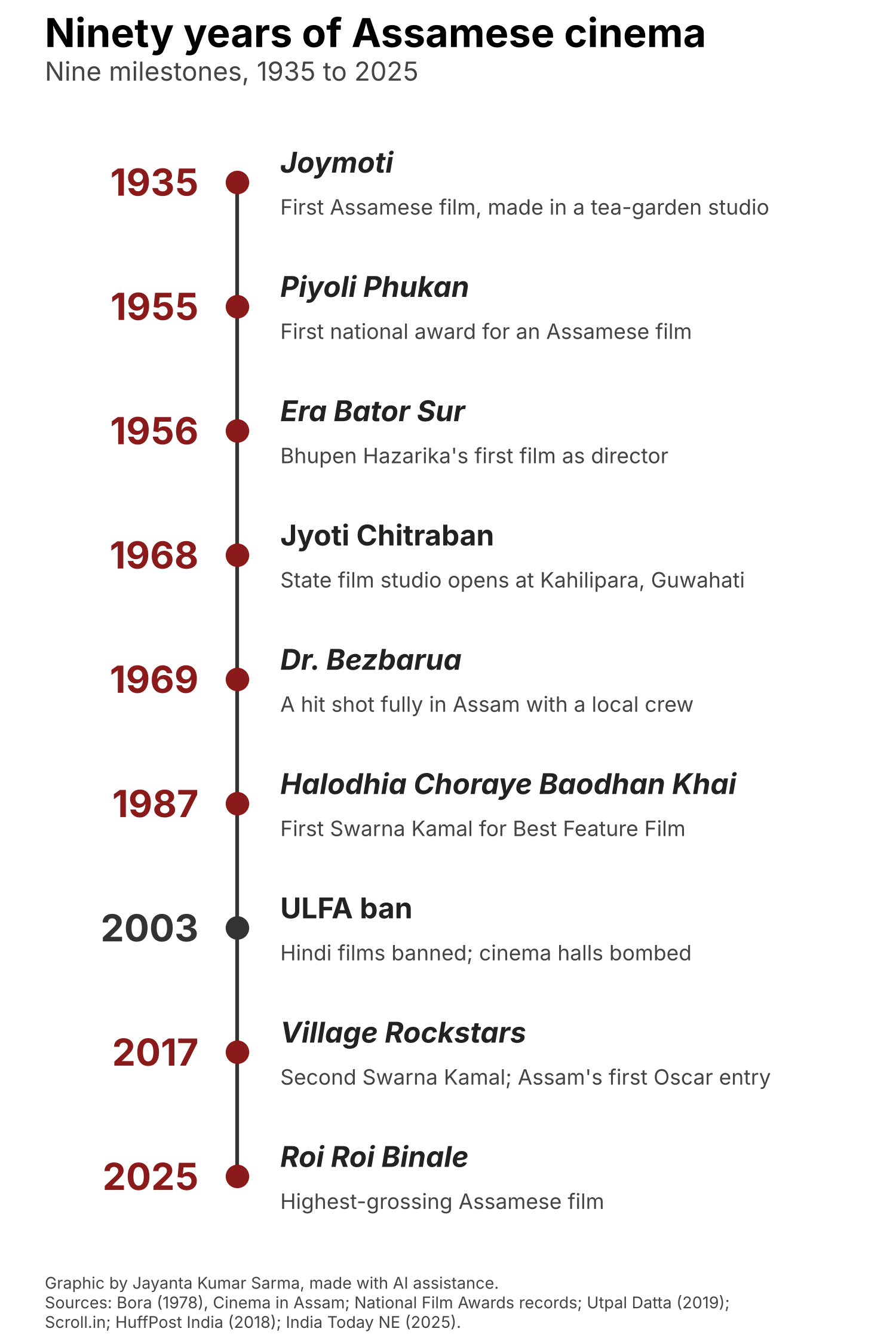
• The first Assamese film, Joymoti, was released on 10 March 1935.
• It was made by Jyoti Prasad Agarwala, whom Assam calls Rupkonwar.
• Halodhia Choraye Baodhan Khai (1987) and Village Rockstars (2017) both won the Swarna Kamal for Best Feature Film.
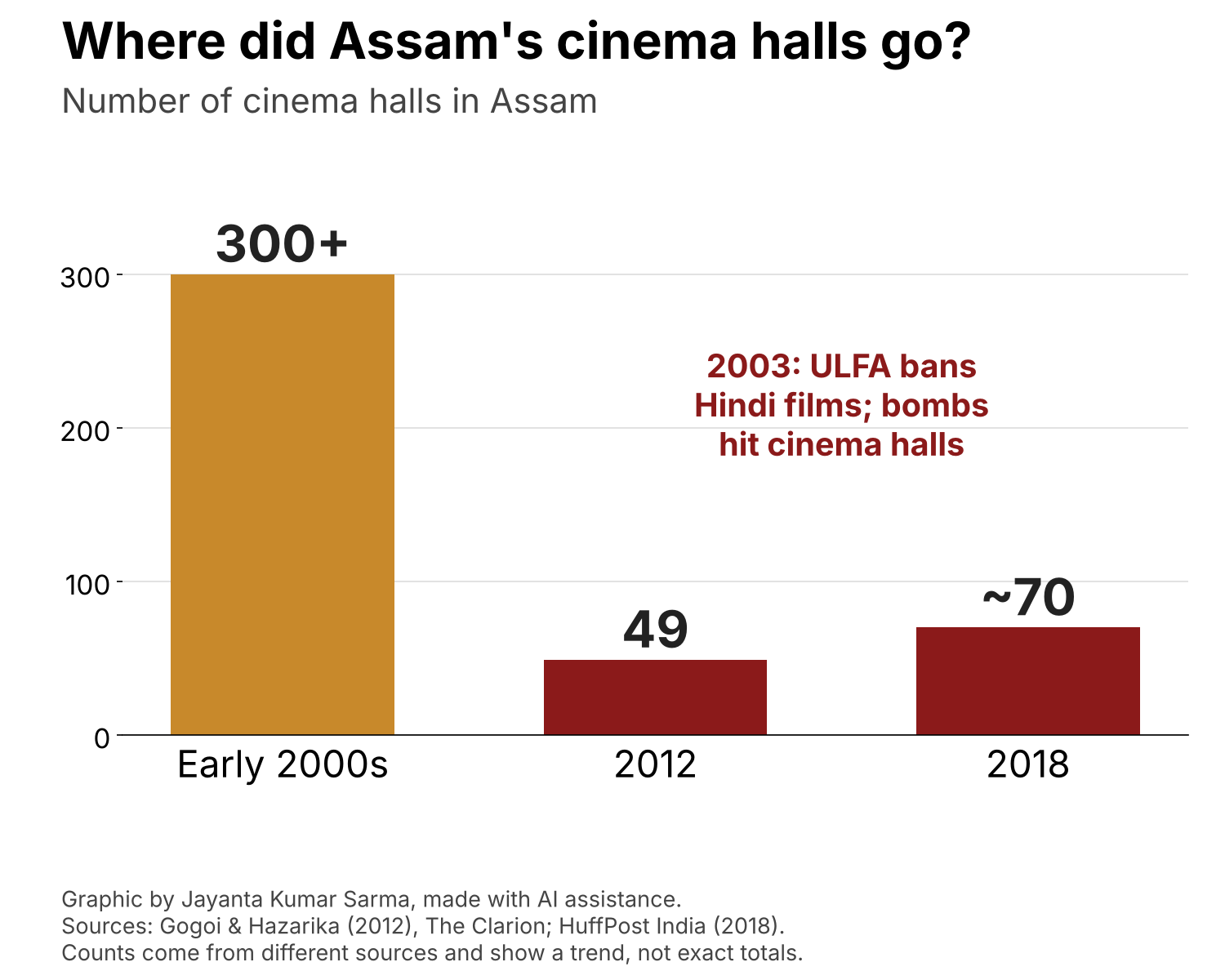
• In 2003, the insurgent group ULFA banned Hindi films in Assam and enforced the ban with bombs in cinema halls.
• Assam had more than 300 cinema halls in the early 2000s; by 2012, only 49 were left.
Born in a tea garden
Assamese cinema did not begin in a city. It began among tea bushes.
In 1933, Jyoti Prasad Agarwala built a makeshift studio, which he called Chitraban, on his family’s Bholaguri Tea Estate, about 60 miles east of Tezpur. The floor was cement. The walls were bamboo mats and banana plants. Ice was carried from Calcutta by steamer and train to develop the film. Tea was processed in the factory by day; actors rehearsed there by night.
Most of his actors had never seen a talkie. When Agarwala reached the editing table, he found that half the film had no sound. With no money to bring the cast back, he hired a studio for a day and dubbed about thirty voices himself, men’s and women’s alike.
Joymoti told the story of an Ahom princess who chose torture and death over betraying her husband. It was political at a time when most Indian films told mythological tales. It placed a woman at the centre. Critic Manoj Barpujari has called it India’s first feminist film.
It also failed at the box office. Assam had hardly a dozen cinema halls in 1935.
That sentence holds the whole story of Assamese cinema in miniature: great films, too few screens.
Recognition first, an industry later
After Agarwala, the stream nearly dried up. Through the 1940s, only a handful of Assamese films were made. There was no studio in Assam, so every film went to Calcutta for shooting, sound and processing. Costs soared, and a market of a few districts could never repay them.
Yet the films kept winning respect. Piyoli Phukan (1955) won a national award. Bhupen Hazarika began directing with Era Bator Sur (1956), a film about tea-garden workers with Lata Mangeshkar singing. In 1968, the state government opened its own studio at Kahilipara, Guwahati, which writer Prafulla Prasad Bora called the first of its kind in India. A year later, Brajen Barua’s thriller Dr. Bezbarua proved that a hit could be shot entirely in Assam with a local crew.
Then came the golden years. Padum Barua, Bhabendra Nath Saikia and Jahnu Barua made quiet, realistic films about ordinary lives. Jahnu Barua’s Halodhia Choraye Baodhan Khai (1987), about a farmer who loses his land to a powerful man, won the Swarna Kamal and prizes at the Locarno festival in Switzerland.
Think of it as a gifted singer with no concert hall. Applause came easily; a paying audience did not.
“We are protecting Assamese culture”: the claim and the data
The claim. In 2003, ULFA banned Hindi films in Assam. The stated aim was to protect Assamese culture from Bollywood. To enforce it, militants set off bombs and lobbed grenades in and around cinema halls.
At first sight, a ban on Hindi films should have helped Assamese films. Fewer rivals, more screens. That was the theory.
The data. Hall owners earned most of their income from Hindi films. Without them, a hall could not survive on the handful of Assamese films released each year. Families, meanwhile, stopped sitting in dark halls where a grenade might go off.
The halls closed. Researchers Debasis Gogoi and Haren Kumar Hazarika counted more than 300 halls a decade earlier, and only 49 by 2012. Many became marriage halls and shopping complexes. By 2018, the state had only about 70.
Other blows landed at the same time. Cheap VCDs let pirates copy a film within days of release. Trained technicians were scarce. And some of the cracks were old: as early as 1968, Bora complained of high costs, reluctant exhibitors and shabby halls.
The rule is simple: you cannot protect a film industry by destroying the places where films are shown. A cinema hall is to a film what a field is to a crop. Burn the field to keep out weeds, and you lose the harvest too.
The comeback: a guitar, a village and a light camera
The technology that helped kill the halls also helped revive the films. Digital cameras made filmmaking cheap. A filmmaker no longer needed Calcutta, a studio or a big crew.
Rima Das is the proof. She had no formal film training. She shot Village Rockstars in her own village, Chhaygaon, near Guwahati, with non-professional actors, and did much of the camera and editing work herself. It is the story of Dhunu, a girl who dreams of owning a real guitar.
In 2018, the film won the Swarna Kamal for Best Feature Film, the first Assamese film to do so in three decades. It became Assam’s first official entry to the Oscars.
Notice the echo. Like Agarwala in 1935, Das did nearly everything herself. The difference is the tool in her hand: a light digital camera instead of heavy celluloid equipment. Same stubbornness, cheaper tools, very different result.
Audiences have returned too. Roi Roi Binale (2025), the last film of singer-actor Zubeen Garg, earned about ₹42 crore by trade estimates, the highest ever for an Assamese film. Hall owners even paused Hindi screenings to give it an exclusive run, by their own choice this time, not at gunpoint.
Cinema in Assam is also speaking more languages. Bodo cinema began with Alayaron in 1986. Karbi, Mising, Rabha and Tiwa films have followed, each telling its community’s story in its own tongue.
So, has Assamese cinema survived?
Yes, but it survived despite its circumstances, not because of them.
For ninety years, the pattern has repeated: brilliant individuals, weak infrastructure. Agarwala built a studio in a tea garden and went broke. Jahnu Barua won at Locarno while halls at home struggled. Rima Das reached the Oscars with a crew of friends. Each success was a personal triumph more than the work of a healthy industry.
The revival is real, but fragile. Screens are still few. Budgets are small. Marketing is weak. A few hits do not make an industry.
What does this mean for you?
The lesson reaches far beyond Assam.
• For any small-language cinema, from Odia to Konkani to Kokborok, talent is rarely the problem. Screens, distribution and steady audiences are.
• For policymakers, protection by force backfires. Assam’s own 1970s experience points the other way: returning entertainment tax to producers and part-financing serious films helped more than any ban.
• For viewers, the choice is simple. A regional film survives on tickets and streams, not applause. Watching a film in your own language, in a hall or on OTT, is a vote for its future.
The honest limits of our research
• Sources disagree on some dates. Bora (1978) dates some films a year earlier than later records, and accounts differ on where Joymoti was edited (Dacca or Lahore).
• Cinema-hall counts come from different studies using different methods, so they show a trend, not exact totals.
• Box-office figures for Assamese films are reported by the industry and are not independently audited.
• Peer-reviewed research on Assamese cinema is thin. Much of the history rests on critics’ writing and a handful of books.
About the research
This article draws on a study unit I prepared on the history of cinema in Assam for distance learners. It cross-checks the work of film critics Utpal Borpujari, Manoj Barpujari and Utpal Datta, all National Film Award winners for film criticism, against Prafulla Prasad Bora’s Cinema in Assam (1978), peer-reviewed studies and National Film Awards records.
Verified external sources
• Datta, U. (2019). Journey of Assamese cinema through the ages. Film Critics Circle of India.
• Deka, V. B. (2021). The world of Assamese celluloid: ‘yesterday and today’. CINEJ Cinema Journal.
• Baishya, A. K. (2017). Restore, revisit, remember: Reinstating the region in three Assamese films. South Asia: Journal of South Asian Studies.
• Barpujari, M. (2013). Assamese cinema: Dreams, reality and dichotomies. In Routledge Handbook of Indian Cinemas.
• Baruah, P. (2024). A History of India’s North-East Cinema. Bloomsbury.
• Bora, P. P. (1978). Cinema in Assam. Performing Arts Centre, Gauhati.
• Gogoi, D., & Hazarika, H. K. (2012). Assamese cinema of India: Birth, development and role & trend. The Clarion.
• Scroll.in. On Dr. Bezbarua (1969) and Utpal Datta’s assessment.
• HuffPost India (2018). How Village Rockstars is sparking a revival of Assamese cinema.
• India Today NE (2025). Cinema hall owners pause Hindi films for Roi Roi Binale.
Pinkvilla (2026). Roi Roi Binale box office: biggest Assamese film of all time with ₹42 crore. Figures are approximate; Assamese cinema has no single box-office tracker.
Assam never lacked films worth watching. It lacked places to watch them
Read the original, and subscribe, at News from Periphery.


No comments:
Post a Comment